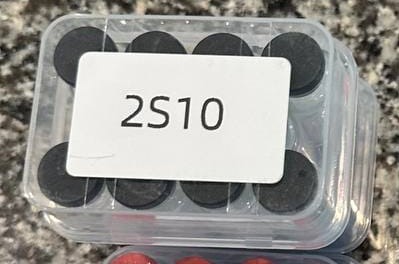
Details from the source.
This catalogue entry records SS-31, 10 mg × 10 vials (SKU 2S10), using the supplied source listing. The cited dossier describes: Human research has examined elamipretide in Barth syndrome and primary mitochondrial myopathy. Cell and animal research has examined mitochondrial dysfunction in other contexts. It also distinguishes available human evidence, limitations, safety concerns, and regulatory context. It does not verify this supplier-specific item’s identity, formulation, lot quality, or approval. This is not medical advice, a treatment recommendation, or authorization for human use.
- Catalogue code
- 2S10
- Source specification
- 10mg*10vials
- Source document
- PriceList(1).pdf, page 1
- Photograph
- Owner-supplied photograph; visible package label matched to this catalogue entry. Supplier identity, lot, and product quality have not been independently verified.
Product information is presented from supplied source materials. Inclusion on this website does not state that a product is an approved medicine or authorize human use. This is educational content, not medical advice.
Compound-level research and safety context.
Evidence below concerns the research family associated with this listing. For blends, findings about individual components do not establish evidence for the combination. This does not verify the supplier-specific vial or lot. Reviewed 2026-10-30.
What it is
SS-31 is described in scientific literature as elamipretide, a synthetic mitochondria-targeting tetrapeptide. That literature identity does not verify the contents of the supplier-specific vials. The available sources do not establish whether these items are compounded or research-only, so neither label is applied.
Biological mechanism
The FDA describes the approved drug Forzinity (elamipretide) as a mitochondrial cardiolipin binder. Experimental membrane studies report that SS-31 interacts with charged lipid bilayers, including mitochondrial membranes, and alters membrane surface electrostatics. Effects on mitochondrial structure and function are proposed, but mechanistic details remain under investigation; laboratory findings do not prove clinical benefit. [2] [5]
Research focus
Human research has examined elamipretide in Barth syndrome and primary mitochondrial myopathy. Cell and animal research has examined mitochondrial dysfunction in other contexts. For the catalogue entries, the supplied PriceList(1).pdf lists the exact family label SS-31: SKU 2S10, *10vials, 84 per 10 vials; and SKU 2S50, *10vials, 330 per 10 vials. The catalogue does not state a currency. These listing details do not verify vial contents.
Potential applications in the evidence
In people, the specific FDA-approved formulation Forzinity is indicated to improve muscle strength in adults and pediatric patients with Barth syndrome who weigh at least 30 kg. FDA granted accelerated approval on the basis of improved knee-extensor strength, an intermediate endpoint considered reasonably likely to predict patient benefit; confirmatory evidence is required. Elamipretide has also been investigated in primary mitochondrial myopathy, but the larger phase 3 study did not meet its primary walking-distance or fatigue outcomes. Other disease contexts are experimental and are not established clinical uses. None of this establishes an application for the catalogued vials. [1] [2] [4] [5]
Human evidence
In a 12-participant randomized crossover Barth syndrome trial, elamipretide did not outperform placebo on the primary six-minute-walk and fatigue endpoints, or on secondary outcomes. In the open-label extension, changes in knee-extensor strength were observed, but an uncontrolled extension cannot establish patient-important benefit. FDA subsequently granted accelerated approval to Forzinity based on knee-extensor strength, and requires a confirmatory trial. In the 218-participant phase 3 MMPOWER-3 trial in primary mitochondrial myopathy, elamipretide did not improve six-minute walking distance or fatigue versus placebo at 24 weeks. [1] [2] [3] [4]
Known and potential effects
Forzinity trials reported local administration reactions including injection-site redness, induration, itch, pain, bruising and urticaria. The FDA label also reports eosinophil-count increases during longer exposure, generally without clinical manifestations. Serious hypersensitivity reactions have been reported, including skin symptoms and respiratory symptoms such as cough. These findings concern the studied Forzinity formulation and do not establish effects or safety for an unverified vial. [2]
Safety and contraindications
The Forzinity label lists serious hypersensitivity to elamipretide or any Forzinity ingredient as a contraindication and warns of serious allergic reactions. It warns of benzyl-alcohol toxicity in neonates for its benzyl-alcohol-containing formulation. These formulation-specific statements cannot be applied directly to the catalogue items because their composition and excipients are unknown. The identity, sterility, quality, manufacturer and lot of the catalogued items have not been verified. [2]
U.S. FDA / regulatory status
FDA granted accelerated approval to Forzinity (elamipretide) injection on 2025-09-19 for improving muscle strength in adults and pediatric patients with Barth syndrome weighing at least 30 kg. The FDA label describes a specific branded sterile solution and states continued approval may depend on confirmation of clinical benefit. This approval is not transferable to all products labelled SS-31 or elamipretide. The supplied catalogue does not identify a manufacturer, lot, formulation source, jurisdiction, or evidence tying either SKU to Forzinity or an FDA application. The FDA status of these exact vials therefore cannot be verified; the available evidence also does not establish that they are compounded or research-only. [1] [2]
Evidence limitations
The Barth controlled trial was very small, its primary walking and fatigue endpoints were not superior to placebo, and later strength observations came from an open-label extension. The FDA approval is accelerated and relies on an intermediate endpoint whose patient benefit must be confirmed. A larger primary mitochondrial myopathy trial was negative on its primary outcomes. Laboratory and animal findings should not be represented as demonstrated human benefits. No source verifies the supplier-specific SKUs' identity, ingredients, strength, dosage form, manufacturer, lot, sterility or regulatory status. The supplied catalogue itself lists 2S10 as *10vials at 84 per 10 vials and 2S50 as *10vials at 330 per 10 vials, with no currency specified. [1] [2] [3] [4] [5]
Supporting sources
- FDA Grants Accelerated Approval to First Treatment for Barth Syndrome U.S. Food and Drug Administration · Official FDA press announcement. Supports: Approval date, limited Barth syndrome indication, accelerated-approval basis, need for confirmatory evidence and serious reactions.
- FORZINITY Prescribing Information U.S. Food and Drug Administration · Official FDA prescribing information. Supports: Approved formulation and indication, label-specific trial evidence, contraindication, warnings and reported adverse reactions.
- A phase 2/3 randomized clinical trial followed by an open-label extension to evaluate the safety and efficacy of elamipretide in patients with Barth syndrome Molecular Genetics and Metabolism; PubMed Central · Peer-reviewed human clinical trial. Supports: Barth syndrome trial design and results, including primary endpoint findings and open-label extension limitations.
- The MMPOWER-3 Randomized Clinical Trial Neurology; PubMed · Peer-reviewed phase 3 human clinical trial abstract. Supports: Phase 3 primary mitochondrial myopathy population, 24-week outcomes and failure to meet primary efficacy endpoints.
- The mitochondria-targeted peptide SS-31 binds lipid bilayers and modulates surface electrostatics as a key component of its mechanism of action Journal of Biological Chemistry; PubMed Central · Peer-reviewed experimental mechanistic study. Supports: SS-31 identity in the scientific literature and experimental membrane-interaction findings relevant to the proposed mechanism.