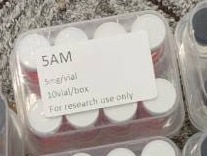
Details from the source.
Source-listed 5-amino-1mq (SKU 5AM): 5mg *10 vials. PriceList(1).pdf lists 43 per 10 vials but does not specify currency; the website displays $43 per 10 vials in USD per owner instruction. The source row does not establish the supplier-specific item's identity, lot quality, or approval.
- Catalogue code
- 5AM
- Source specification
- 5mg *10 vials
- Source document
- PriceList(1).pdf, page 4
- Photograph
- Owner-supplied photograph; visible package label matched to this catalogue entry. Supplier identity, lot, and product quality have not been independently verified.
Product information is presented from supplied source materials. Inclusion on this website does not state that a product is an approved medicine or authorize human use. This is educational content, not medical advice.
Compound-level research and safety context.
Evidence below concerns the research family associated with this listing. For blends, findings about individual components do not establish evidence for the combination. This does not verify the supplier-specific vial or lot. Reviewed 2026-10-30.
What it is
The compound studied in literature under the name 5-amino-1MQ is a small-molecule NNMT inhibitor, not a peptide. The catalog label is preserved verbatim, but the alias alone does not verify the exact contents or chemical form of these supplier-specific vials.
Biological mechanism
NNMT normally transfers a methyl group from S-adenosyl-methionine (SAM) to nicotinamide, producing 1-methylnicotinamide and S-adenosyl-homocysteine. In cultured adipocytes, 5-amino-1MQ reduced 1-methylnicotinamide and increased intracellular NAD+ and SAM. Proposed downstream metabolic effects remain preclinical and have not been established in people. [1] [2]
Research focus
Research has examined NNMT inhibition in cell models of adipocyte metabolism and in animal models of obesity-related metabolic changes. A later study examined 5-amino-1MQ alongside a low-fat diet in mice and reported microbiome changes as a basis for further investigation. [1] [3]
Potential applications in the evidence
Only preclinical research directions are supported: modifying adipocyte lipid metabolism and studying obesity-associated metabolic measures in cells and diet-induced-obesity mice. These findings do not establish clinical use or benefit for obesity, diabetes, or any other condition in people. [1] [2] [3]
Human evidence
No human intervention study of 5-amino-1MQ was identified in the sources reviewed. The 2021 review stated that NNMT-targeting clinical trials had not been reported, and ClinicalTrials.gov searches for “5-amino-1MQ” and “5-amino-1-methylquinolinium” returned no records when checked for this note. Human studies of NNMT-related biomarkers do not show that this inhibitor has effects in people. [2] [4]
Known and potential effects
In vitro, 5-amino-1MQ lowered the NNMT product 1-methylnicotinamide and altered intracellular NAD+ and SAM in cultured adipocytes; cell experiments also reported reduced lipid accumulation. In diet-induced-obesity mice, studies reported lower body weight and white-fat measures. One short mouse study reported no observable adverse effects, which is not evidence of human safety. In a cell-viability experiment, higher tested concentrations produced modest cytotoxicity, with greater cytotoxicity at the highest test level. [1] [3]
Safety and contraindications
Human adverse effects, interactions, contraindications, and long-term risks are not established. The limited mouse observation cannot establish safety, and the cell cytotoxicity findings warrant caution without defining a human risk profile. The price list does not verify the vials’ identity, purity, sterility, manufacturing quality, or labeling. No specific clinical contraindication can be reliably stated from the evidence reviewed.
U.S. FDA / regulatory status
No reviewed source establishes FDA approval of a drug containing 5-amino-1MQ or an approved indication for this catalog item. FDA’s Drugs@FDA search is an official source for approved drugs, but its interactive search presented a human-verification challenge during this review, so a direct database query could not be completed. FDA’s January 2026 warning letter stated that a specific outsourcing facility’s bulk substance named 5-amino-1-methylquinolinium iodide was not eligible for section 503B compounding exemptions because it was not on the applicable bulk-substance list and was not used for a drug on the shortage list. That finding is limited to the specific substance and facility addressed; it does not verify this catalog vial’s salt form or establish that this item is compounded. The supplied listing does not identify a manufacturer, lot, formulation source, jurisdiction, or approval, so FDA status for the exact vial cannot be verified. [5] [6]
Evidence limitations
Evidence is limited to cell and animal research and does not establish effectiveness or safety in humans. No human intervention evidence was identified. The catalog’s chemical alias does not verify the vial’s exact identity or formulation; the FDA compounding warning concerns a named iodide bulk substance used by a particular facility and cannot be transferred to the supplier-specific catalog item. The listed prices have no stated currency.
Supporting sources
- Selective and membrane-permeable small molecule inhibitors of nicotinamide N-methyltransferase reverse high fat diet-induced obesity in mice Biochemical Pharmacology; PubMed Central · Peer-reviewed primary study. Supports: Compound identity as a small molecule, NNMT mechanism, adipocyte experiments, mouse findings, and reported cell cytotoxicity and limited animal adverse-effect observations.
- Roles of Nicotinamide N-Methyltransferase in Obesity and Type 2 Diabetes BioMed Research International; PubMed Central · Peer-reviewed review. Supports: NNMT biochemical pathway, research context, preclinical evidence, and the review's statement that NNMT-targeting clinical trials had not been reported as of 2021.
- Reduced calorie diet combined with NNMT inhibition establishes a distinct microbiome in DIO mice Scientific Reports · Peer-reviewed animal study. Supports: Additional mouse-only research and limitations for combined NNMT inhibition and diet findings.
- ClinicalTrials.gov search for 5-amino-1-methylquinolinium U.S. National Library of Medicine, ClinicalTrials.gov · Official clinical trial registry search. Supports: Registry search returned no records for the full compound name when checked for this note; this is not proof that no unregistered study exists.
- GenoGenix LLC MARCS-CMS 718739 — January 20, 2026 U.S. Food and Drug Administration · FDA warning letter. Supports: FDA's facility-specific finding concerning 5-amino-1-methylquinolinium iodide and section 503B compounding exemptions; does not establish the catalog vial's identity or category.
- Drugs@FDA: FDA-Approved Drugs U.S. Food and Drug Administration · Official FDA database. Supports: Identifies Drugs@FDA as the official approved-drug search source; its interactive query was blocked by a human-verification challenge during this review.