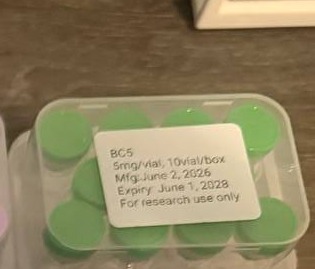
Details from the source.
This catalogue entry records BPC-157, 5 mg × 10 vials (SKU BC5), using the supplied source listing. The cited dossier describes: Research has focused largely on animal models of musculoskeletal injury and tissue repair, as well as gastrointestinal mucosal protection and wound-healing models. It also distinguishes available human evidence, limitations, safety concerns, and regulatory context. It does not verify this supplier-specific item’s identity, formulation, lot quality, or approval. This is not medical advice, a treatment recommendation, or authorization for human use.
- Catalogue code
- BC5
- Source specification
- 5mg*10vials
- Source document
- PriceList(1).pdf, page 1
- Photograph
- Owner-supplied photograph; visible package label matched to this catalogue entry. Supplier identity, lot, and product quality have not been independently verified.
Product information is presented from supplied source materials. Inclusion on this website does not state that a product is an approved medicine or authorize human use. This is educational content, not medical advice.
Compound-level research and safety context.
Evidence below concerns the research family associated with this listing. For blends, findings about individual components do not establish evidence for the combination. This does not verify the supplier-specific vial or lot. Reviewed 2026-10-30.
What it is
A synthetic 15-amino-acid peptide (pentadecapeptide), according to scientific literature. The exact catalogue label is “BPC 157”; the source does not identify whether its vial is free base, acetate, or another form. The catalogue lists BC5 (*10vials; price 36 per 10 vials) and BC10 (*10vials; price 58 per 10 vials); currency is not stated. Compound-level literature does not authenticate or identify either vial. [1] [3]
Biological mechanism
Cell and animal studies propose effects on VEGFR2–Akt–eNOS/nitric-oxide and ERK/MAPK signaling, angiogenesis, fibroblast activity, and inflammatory responses. These are mainly preclinical findings; a clinically validated mechanism in people has not been established. [3]
Research focus
Research has focused largely on animal models of musculoskeletal injury and tissue repair, as well as gastrointestinal mucosal protection and wound-healing models. Limited human reports address knee pain, interstitial cystitis, and safety observations; FDA also reviewed limited rectal-enema studies in ulcerative colitis. [1] [3] [4]
Potential applications in the evidence
Investigated topics include tissue repair in preclinical musculoskeletal and wound models, gastrointestinal conditions, and small human pilot reports involving knee pain and interstitial cystitis. These are research areas only, not established indications or evidence that the catalogue item provides benefit. [1] [3] [4]
Human evidence
Human evidence is insufficient to establish efficacy or safety. A frequently cited knee-pain study was retrospective: 16 patients were reached for follow-up, including 12 given BPC-157 alone and four given BPC-157 with TB4. Outcomes were self-reported, diagnoses varied, and there was no control group or standardized functional measure, so causation cannot be established; combination results do not prove standalone effects. FDA's 2026 review described two short rectal-enema studies with limited safety monitoring. A registered phase 2 hamstring-strain trial was recruiting on its last-posted record and had no results posted. [1] [4] [5]
Known and potential effects
Human harms are not adequately characterized. FDA reported FAERS adverse-event reports including injection-site reaction, shortness of breath, and diffuse hyperpigmentation with gingival darkening, while noting that causality was unclear and the reports were difficult to interpret. Small studies reporting no serious events do not establish safety. [1]
Safety and contraindications
FDA identified concerns about incomplete characterization, peptide-related impurities, aggregation, and potential immunogenicity; these may vary with formulation, concentration, storage, and route. FDA found insufficient clinical safety information for the proposed routes it reviewed. The sources reviewed did not establish contraindications for this exact vial or provide an approved label for it; this lack of information is not evidence of safety. [1]
U.S. FDA / regulatory status
The sources reviewed do not verify an FDA-approved BPC-157 drug product or indication. FDA's May 2026 staff briefing proposed that BPC-157 free base and acetate not be added to the 503A bulk list. The July 2026 Pharmacy Compounding Advisory Committee meeting was advisory and nonbinding; the FDA briefing states that FDA would make no final determination until the advisory process and reviews were complete. No subsequent final FDA listing determination was verified as of 2026-10-30. Compounding-list consideration is distinct from approval of a finished drug. The price list does not establish whether the supplier-specific vial is FDA-approved, compounded, or research-only. [1] [2] [6]
Evidence limitations
Most evidence is preclinical. Human reports are few and limited by small samples, retrospective or uncontrolled designs, short follow-up, varied routes/formulations, and incomplete safety monitoring. Animal or cell findings do not establish human efficacy. Trial registration without results does not resolve these gaps. Compound-level evidence cannot establish the identity, purity, quality, safety, or performance of BC5 or BC10. [1] [3] [4] [5]
Supporting sources
- FDA Briefing Document for BPC-157-Related Bulk Drug Substances U.S. Food and Drug Administration · FDA staff briefing document. Supports: FDA staff evaluation and proposal on 503A listing; substance characterization, routes and limited human safety evidence; potential immunogenicity/impurity concerns; FAERS reports and limitations.
- Bulk Drug Substances Used in Compounding Under Section 503A U.S. Food and Drug Administration · FDA regulatory information page. Supports: General FDA 503A bulk-substance eligibility requirements and the distinction between approved-drug components and listed bulk substances.
- Emerging Use of BPC-157 in Orthopaedic Sports Medicine: A Systematic Review HSS Journal / SAGE; full text hosted by PubMed Central · Peer-reviewed systematic review. Supports: Peptide classification, proposed mechanism, preclinical emphasis, and the limited human evidence and safety gaps in musculoskeletal research.
- Intra-Articular Injection of BPC 157 for Multiple Types of Knee Pain Alternative Therapies in Health and Medicine; indexed by PubMed, U.S. National Library of Medicine · Primary retrospective human study. Supports: Study design, sample sizes, self-reported outcomes, standalone and TB4-combination groups, and methodological limitations.
- BPC 157 for Acute Hamstring Muscle Strain Repair ClinicalTrials.gov, U.S. National Library of Medicine · Clinical trial registry. Supports: Registered phase 2 trial status and absence of posted results on the reviewed record.
- July 23-24, 2026 Meeting of the Pharmacy Compounding Advisory Committee U.S. Food and Drug Administration · FDA advisory committee meeting page. Supports: 2026 committee consideration of BPC-157-related substances and the nonbinding nature of advisory committee recommendations.