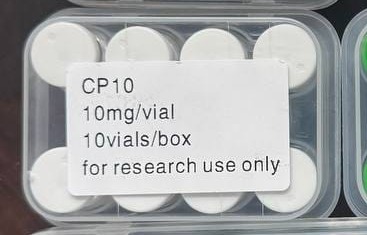
Details from the source.
This catalogue entry records CJC-1295 + Ipamorelin, 10 mg × 10 vials (SKU CP10), using the supplied source listing. The cited dossier describes: Separate research on CJC-1295 has examined GH and IGF-1 responses. Ipamorelin research has examined GH-secretagogue pharmacology and, in a human Phase 2 study, postoperative ileus. These contexts concern individual substances or particular research formulations, not the listed combination. It also distinguishes available human evidence, limitations, safety concerns, and regulatory context. It does not verify this supplier-specific item’s identity, formulation, lot quality, or approval. This is not medical advice, a treatment recommendation, or authorization for human use.
- Catalogue code
- CP10
- Source specification
- 10mg*10vials
- Source document
- PriceList(1).pdf, page 2
- Photograph
- Owner-supplied photograph; visible package label matched to this catalogue entry. Supplier identity, lot, and product quality have not been independently verified.
Product information is presented from supplied source materials. Inclusion on this website does not state that a product is an approved medicine or authorize human use. This is educational content, not medical advice.
Compound-level research and safety context.
Evidence below concerns the research family associated with this listing. For blends, findings about individual components do not establish evidence for the combination. This does not verify the supplier-specific vial or lot. Reviewed 2026-10-30.
What it is
The catalogue describes a blend of peptide components. CJC-1295 is scientifically described as a GHRH-analogue peptide and ipamorelin is a synthetic pentapeptide, but the exact contents and chemical forms of the supplier-specific vial are not independently verified. In particular, the source does not expand ‘IPA’; it may mean ipamorelin, but that requires owner confirmation. Do not characterize the exact vial as compounded or research-only on the available information. Catalogue SKU CP10 lists *10vials at 101 per 10 vials; no currency is stated.
Biological mechanism
If the names refer to the usual research compounds, CJC-1295/GHRH-like activity stimulates pituitary GHRH receptors and promotes growth hormone (GH) release, while ipamorelin acts as a ghrelin-receptor agonist that stimulates GH release. These are distinct receptor pathways. The expected joint effect is only a mechanistic hypothesis; it has not been established for this catalogue blend. Human CJC-1295 studies cited here used a long-acting albumin-binding formulation and do not verify the product’s ‘without DAC’ identity.
Research focus
Separate research on CJC-1295 has examined GH and IGF-1 responses. Ipamorelin research has examined GH-secretagogue pharmacology and, in a human Phase 2 study, postoperative ileus. These contexts concern individual substances or particular research formulations, not the listed combination. Animal and in-vitro findings do not establish human benefit.
Potential applications in the evidence
Only investigated contexts can be described: GH/IGF-1 biomarker response with a long-acting CJC-1295 formulation, and postoperative ileus with standalone intravenous ipamorelin. These are research areas, not established applications for the CP10 listing. There is no direct clinical evidence identified for this blend; standalone findings do not prove combination efficacy.
Human evidence
Small randomized studies in healthy adults found increased GH and IGF-1 after a long-acting, albumin-binding CJC-1295 formulation; they do not establish clinical benefit, long-term safety, or effects of the catalogue’s ‘without DAC’ component. A Phase 2 placebo-controlled study of ipamorelin for postoperative ileus reported a median time to first tolerated meal of 25.3 versus 32.6 hours, a non-significant difference (p=0.15). The study was small and addressed a specific postoperative setting. FDA’s 2024 review noted limited clinical evidence and no supporting data for the proposed subcutaneous route for the conditions evaluated. No human trial of the exact listed blend was identified.
Known and potential effects
The long-acting CJC-1295 formulation increased circulating GH and IGF-1 in small human studies. Ipamorelin stimulated GH release in laboratory and animal pharmacology studies. In the ipamorelin postoperative trial, treatment-emergent adverse events were reported in 87.5% of the ipamorelin group and 94.8% of placebo; the study was not evidence of effectiveness for this blend. FDA’s CJC-1295 compounding-risk page records reports of increased heart rate and systemic vasodilatory reaction. FDA also notes reports of serious events, including death, in literature involving intravenous ipamorelin for gastric motility. These findings do not establish that the exact CP10 vial causes any particular effect.
Safety and contraindications
Available data are too limited to establish the safety profile of this exact combination, identity, formulation, route, or product quality. FDA flags possible immunogenicity, peptide aggregation and peptide-related impurities/characterization concerns for compounding evaluations. The CJC-1295 and ipamorelin warnings arise from distinct regulatory/source contexts and should not be assumed to identify the composition of this vial. FDA’s ipamorelin review also discusses nonclinical possible behavioral-reinforcement and reproductive/pregnancy concerns; relevance to this product is unknown. No product-specific contraindication list can be verified.
U.S. FDA / regulatory status
The reviewed FDA briefing states that neither ipamorelin free base nor ipamorelin acetate is a component of an FDA-approved drug; it evaluated these substances for compounding and said the criteria weighed against placing them on the 503A bulk list. FDA’s current compounding-risk page lists ipamorelin acetate under 503B Category 2 and describes risks. The same page lists CJC-1295 among withdrawn bulk-substance nominations and records safety concerns. These compounding-list entries are not approval determinations for CP10, and do not establish that this vial is compounded. No approval for the exact supplier-specific vial can be verified because its manufacturer, lot, formulation source, jurisdiction and approval identifiers are absent. Approval of an active ingredient or different formulation would not transfer to this vial.
Evidence limitations
Exact vial identity, component forms, manufacturing, quality, route, regulatory jurisdiction and approval are unverified. The name ‘without DAC’ does not establish that the supplier material matches a specific published molecule; the human CJC-1295 data reviewed concern the long-acting albumin-binding formulation. ‘IPA’ is not expanded in the supplied listing. Human evidence is limited and component-specific; no direct combination clinical evidence was identified. Hormone biomarker changes and animal/in-vitro findings do not establish meaningful clinical outcomes or long-term safety. Do not infer efficacy, safety, or an approval status for the catalogued vial from these data.
Supporting sources
- Certain Bulk Drug Substances for Use in Compounding that May Present Significant Safety Risks U.S. Food and Drug Administration · Regulator safety / compounding status page. Supports: FDA’s current compounding-risk descriptions for CJC-1295 and ipamorelin acetate, including reported CJC-1295 serious adverse events and peptide characterization/immunogenicity concerns; supports the limited, non-product-specific regulatory status discussion.
- Prolonged stimulation of growth hormone and insulin-like growth factor I secretion by CJC-1295, a long-acting analog of GH-releasing hormone, in healthy adults Journal of Clinical Endocrinology & Metabolism; PubMed, U.S. National Library of Medicine · Randomized human clinical study. Supports: Human GH/IGF-1 biomarker findings in healthy adults and the fact that the studied CJC-1295 was the long-acting formulation; does not establish effects of the listed no-DAC component.
- Ipamorelin, the first selective growth hormone secretagogue European Journal of Endocrinology; PubMed, U.S. National Library of Medicine · Primary pharmacology study, in-vitro and animal findings. Supports: Ipamorelin’s peptide nature, receptor pharmacology and preclinical GH-secretagogue findings; not proof of human clinical efficacy.
- Prospective, randomized, controlled, proof-of-concept study of the ghrelin mimetic ipamorelin for the management of postoperative ileus in bowel resection patients International Journal of Colorectal Disease; PubMed, U.S. National Library of Medicine · Phase 2 randomized human clinical study. Supports: Human standalone ipamorelin evidence for postoperative ileus, reported adverse-event frequency, and non-significant primary efficacy endpoint.
- FDA Briefing Document: Ipamorelin-Related Bulk Drug Substances U.S. Food and Drug Administration · Regulatory briefing / compounding safety evaluation. Supports: FDA’s assessment of ipamorelin free base and acetate, absence as components of FDA-approved drugs, compounding-list evaluation, limitations in human evidence, and safety concerns.