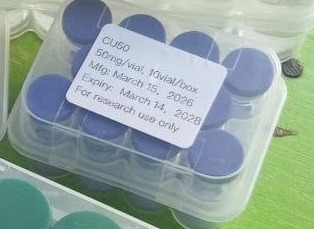
Details from the source.
This catalogue entry records GHK-Cu, 50 mg × 10 vials (SKU CU50), using the supplied source listing. The cited dossier describes: Research has focused chiefly on skin remodeling, wound repair, collagen-related outcomes, and topical cosmetic formulations. Other proposed areas, including inflammatory or pulmonary conditions, remain exploratory and are not established uses. It also distinguishes available human evidence, limitations, safety concerns, and regulatory context. It does not verify this supplier-specific item’s identity, formulation, lot quality, or approval. This is not medical advice, a treatment recommendation, or authorization for human use.
- Catalogue code
- CU50
- Source specification
- 50mg*10vials
- Source document
- PriceList(1).pdf, page 3
- Photograph
- Owner-supplied photograph; visible package label matched to this catalogue entry. Supplier identity, lot, and product quality have not been independently verified.
Product information is presented from supplied source materials. Inclusion on this website does not state that a product is an approved medicine or authorize human use. This is educational content, not medical advice.
Compound-level research and safety context.
Evidence below concerns the research family associated with this listing. For blends, findings about individual components do not establish evidence for the combination. This does not verify the supplier-specific vial or lot. Reviewed 2026-10-30.
What it is
GHK-Cu is a copper(II) complex of GHK, a naturally occurring tripeptide (glycyl-L-histidyl-L-lysine). It is peptide-containing. The catalogue label alone does not verify that the listed vial contents are GHK-Cu or establish their formulation or route.
Biological mechanism
GHK binds copper(II). Laboratory and animal research suggests effects on copper handling and on extracellular-matrix turnover, collagen and glycosaminoglycan synthesis, matrix metalloproteinases, inflammation, and tissue-repair signaling. The mechanism is not fully resolved, and much of this evidence is preclinical; it does not establish clinical effects.
Research focus
Research has focused chiefly on skin remodeling, wound repair, collagen-related outcomes, and topical cosmetic formulations. Other proposed areas, including inflammatory or pulmonary conditions, remain exploratory and are not established uses.
Potential applications in the evidence
Investigated possibilities include topical skin appearance and wound-healing research. Older small human studies of distinct topical cosmetic formulations have reported skin-related outcomes, but findings do not establish efficacy for the catalogue vials, other routes, or disease treatment. No therapeutic benefit for this specific item is established.
Human evidence
A peer-reviewed review summarizes older topical studies, including facial or eye creams studied in groups of 71 and 41 women over 12 weeks and a thigh-skin study. Those studies concern specific topical formulations and do not establish efficacy or safety of these catalogue vials or injectable use. A later review highlights sparse clinical evidence for topical GHK-Cu anti-wrinkle performance. A registered phase 2 topical wound study is recruiting; ClinicalTrials.gov showed no posted results as of this review.
Known and potential effects
The evidence does not establish a comprehensive adverse-effect profile for these vials or systemic use. Pain, itch, redness, burning, stinging, and infection are outcomes monitored in the ongoing topical wound study, not confirmed effects of this catalogue product. FDA identifies potential immunogenicity concerns for compounded injectable GHK-Cu related to aggregation and peptide-related impurities, with limited human safety data.
Safety and contraindications
Route, excipients, sterility, quality controls, and contraindications are not provided, so these cannot be verified. Topical experience must not be treated as evidence of safety for injection or other routes. FDA specifically identifies potential immunogenicity concerns for compounded injectable GHK-Cu and notes limited human safety data. No contraindication list specific to these vials can be established from the supplied materials.
U.S. FDA / regulatory status
No FDA approval for GHK-Cu itself was verified in the sources reviewed. FDA's May 14, 2026 503A bulks document lists “GHK-Cu (except for injectable routes of administration)” in Category 1 under evaluation and says FDA intends to consult its Pharmacy Compounding Advisory Committee before the end of February 2027; this is not FDA approval. FDA separately identifies safety concerns for compounded injectable GHK-Cu. The source listing does not establish that the items are compounded, research-only, or approved. Approval of a different active ingredient or branded formulation, if any, does not transfer to these supplier-specific vials.
Evidence limitations
The supplied PriceList(1).pdf lists exact label GHK-CU and source SKUs CU50 (*10vials; 25 per 10 vials) and CU100 (*10vials; 43 per 10 vials); no currency is stated. These are source listing details, not verification of vial identity. The catalogue does not identify manufacturer, lot, formulation source, jurisdiction, route, quality documentation, or approval. Mechanistic results largely derive from in-vitro, tissue, animal, or gene-expression research. Older topical human findings concern different formulations, and the current wound trial has no posted results. Exact-vial identity and status remain unverified.
Supporting sources
- Regenerative and Protective Actions of the GHK-Cu Peptide in the Light of the New Gene Data International Journal of Molecular Sciences / PubMed Central · Peer-reviewed review. Supports: Peptide identity, proposed mechanisms, preclinical tissue-repair evidence, and historical small human topical cosmetic study reports.
- Topically applied GHK as an anti-wrinkle peptide: Advantages, problems and prospective Bioimpacts / PubMed · Peer-reviewed review. Supports: Topical research, formulation and permeability issues, and limits of the clinical evidence.
- Topical GHK-Cu Gel for Acute Skin Wound Healing ClinicalTrials.gov, U.S. National Library of Medicine · Clinical trial registry. Supports: Current recruiting phase 2 trial design and the absence of posted results; symptoms monitored as study outcomes.
- Certain Bulk Drug Substances for Use in Compounding May Present Significant Safety Risks U.S. Food and Drug Administration · Regulatory safety communication. Supports: FDA-stated potential immunogenicity risks for compounded injectable GHK-Cu, aggregation and peptide impurities, and limited human safety data.
- Bulk Drug Substances Nominated for Use in Compounding Under Section 503A, updated May 14, 2026 U.S. Food and Drug Administration · Regulatory database/list. Supports: GHK-Cu non-injectable Category 1 under evaluation and planned PCAC consultation; distinction from drug approval.
- Drugs@FDA: FDA-Approved Drugs U.S. Food and Drug Administration · Official approval database. Supports: Scope of the FDA-approved human drugs database; an approval or listing for a different product would not establish approval of these vials.