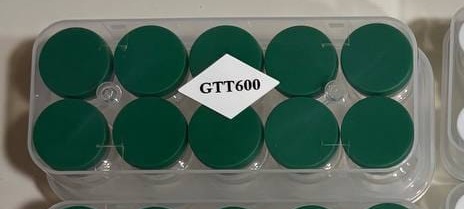
Details from the source.
Source-listed Glutathione (SKU GTT600): 600mg*10vials. PriceList(1).pdf lists 38 per 10 vials but does not specify currency; the website displays $38 per 10 vials in USD per owner instruction. The source row does not establish the supplier-specific item's identity, lot quality, or approval.
- Catalogue code
- GTT600
- Source specification
- 600mg*10vials
- Source document
- PriceList(1).pdf, page 4
- Photograph
- Owner-supplied photograph; visible package label matched to this catalogue entry. Supplier identity, lot, and product quality have not been independently verified.
Product information is presented from supplied source materials. Inclusion on this website does not state that a product is an approved medicine or authorize human use. This is educational content, not medical advice.
Compound-level research and safety context.
Evidence below concerns the research family associated with this listing. For blends, findings about individual components do not establish evidence for the combination. This does not verify the supplier-specific vial or lot. Reviewed 2026-10-30.
What it is
Glutathione is a naturally occurring tripeptide (three amino acids), so chemically it is a peptide; it is not a peptide hormone. The catalogue lists GTT600 as *10vials at 38 per 10 vials and GTT1500 as *10vials at 76 per 10 vials; the currency is not stated. The source does not specify redox form, salt, purity, formulation, manufacturer, route, or intended use.
Biological mechanism
Endogenous glutathione participates in cellular redox balance. Glutathione peroxidase uses reduced glutathione to reduce peroxides, producing oxidized glutathione; glutathione reductase can recycle it using NADPH. It also participates in enzymatic conjugation reactions involved in processing some reactive compounds. These biochemical roles do not establish clinical benefits from these particular vials. [1]
Research focus
Human supplementation studies have examined changes in blood and cellular glutathione measures, with some secondary oxidative-stress or immune-function biomarkers. Skin-pigmentation effects have also been explored in small route- and formulation-specific trials. Laboratory and animal research investigates antioxidant, redox, and pigmentation mechanisms; it is not proof of human benefit. [2] [3] [4]
Potential applications in the evidence
Investigated applications include changing glutathione stores or related biomarkers through oral supplementation and possible changes in skin pigmentation with oral or parenteral formulations. Evidence is limited and does not establish prevention or treatment of disease, durable skin-lightening outcomes, or effects of GTT600/GTT1500. Do not transfer findings from particular oral or injectable formulations to these unidentified catalogue vials. [2] [3] [4]
Human evidence
A six-month randomized, double-blind, placebo-controlled study of 54 healthy nonsmokers found increases in some blood and cell glutathione measures with oral supplementation; levels moved toward baseline after a one-month washout. It assessed biomarkers rather than disease outcomes. [2] A one-month liposomal oral pilot enrolled 12 healthy adults, six per group; it reported changes in some glutathione and immune-function markers but was too small to establish clinical outcomes. [3] A review of three small randomized trials of systemic glutathione for skin lightening found mixed, limited, and non-durable results. These findings are formulation- and route-specific and cannot establish effects of the catalogue vials. [4]
Known and potential effects
Mild gastrointestinal complaints have been reported in oral studies; uncommon and long-term effects are insufficiently characterized. In 2026, FDA and CDC described illnesses following injectable glutathione products compounded using dietary-supplement-grade ingredients, including fever, chills, body aches, headache, nausea, dizziness, and low blood pressure; some people were hospitalized. FDA notes excessive endotoxin exposure can cause severe reactions, shock, and death. These reports concern contaminated or unsuitable ingredients and do not establish that the glutathione molecule itself caused each event. [4] [5] [6]
Safety and contraindications
The catalogue does not say whether the vials are sterile, injectable, oral, topical, or intended for another use. Product-specific safety, contraindications, and compatibility cannot be verified. FDA and CDC warn that dietary-supplement-grade glutathione is not appropriate for compounding sterile injectables and that ingredient source and grade matter. The available information cannot determine whether the listed vials are associated with any particular warning or recall. [5] [6]
U.S. FDA / regulatory status
CDC states that there are no FDA-approved glutathione products in the United States. The catalogue supplies no manufacturer, upstream ingredient source, lot, formulation, route, jurisdiction, FDA approval number, or regulatory documents; the FDA approval or marketing status of these exact vials therefore cannot be verified. Do not transfer an approval or regulatory status from another glutathione product to GTT600 or GTT1500. There is no supplied evidence establishing that these items are compounded or research-only. [5]
Evidence limitations
Human studies are small and use differing formulations, routes, durations, and endpoints. Biomarker changes are not equivalent to demonstrated health benefits. Skin-pigmentation findings are mixed and not clearly durable. Laboratory or animal mechanisms are not human efficacy evidence. No cited study verifies the identity, quality, safety, or effect of these exact catalogue vials. The PDF provides the listed amounts and prices but no currency or product details beyond the name and specification.
Supporting sources
- Glutathione-Related Enzymes and Proteins: A Review Molecules / PubMed Central · Peer-reviewed review. Supports: Glutathione redox biology, peroxidase/reductase cycle, and conjugation functions.
- Randomized controlled trial of oral glutathione supplementation on body stores of glutathione European Journal of Nutrition / PubMed · Randomized controlled human trial. Supports: Human oral supplementation findings, study size and duration, measured biomarkers, and limits.
- Oral supplementation with liposomal glutathione elevates body stores of glutathione and markers of immune function in healthy adults Nutrients / PubMed Central · Pilot human study. Supports: Small one-month liposomal oral pilot, measured biomarkers, and sample-size limitations.
- Systemic Glutathione as a Skin-Whitening Agent in Adult Dermatology Research and Practice / PubMed Central · Evidence-based review. Supports: Small systemic skin-pigmentation trials, mixed results, durability, and route-specific tolerability.
- Adverse Events Linked to Injectable Glutathione Compounded with Dietary Supplement Grade Ingredient: Current Situation U.S. Centers for Disease Control and Prevention · Public health safety communication. Supports: 2026 injectable-glutathione illness investigation, endotoxin concerns, and CDC statement that there are no FDA-approved glutathione products in the United States.
- FDA reminds compounders not to use dietary supplement grade glutathione for injectables U.S. Food and Drug Administration · Regulatory safety communication. Supports: FDA's 2026 warning, reported reactions, ingredient-quality concerns, and the distinction between specific compounded products and these unidentified catalogue vials.