Details from the source.
This catalogue entry records Ipamorelin, 5 mg × 10 vials (SKU IP5), using the supplied source listing. The cited dossier describes: Research has examined ipamorelin as a growth-hormone secretagogue. A human phase 2 study also evaluated it for postoperative ileus after bowel resection. It also distinguishes available human evidence, limitations, safety concerns, and regulatory context. It does not verify this supplier-specific item’s identity, formulation, lot quality, or approval. This is not medical advice, a treatment recommendation, or authorization for human use.
- Catalogue code
- IP5
- Source specification
- 5mg*10vials
- Source document
- PriceList(1).pdf, page 3
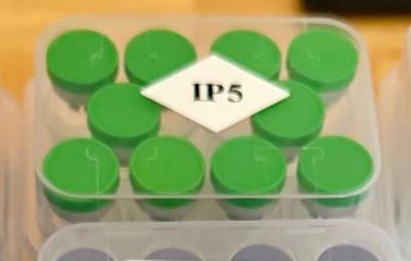
- Photograph
- Owner-supplied photograph; visible package label matched to this catalogue entry. Supplier identity, lot, and product quality have not been independently verified.
Product information is presented from supplied source materials. Inclusion on this website does not state that a product is an approved medicine or authorize human use. This is educational content, not medical advice.
Compound-level research and safety context.
Evidence below concerns the research family associated with this listing. For blends, findings about individual components do not establish evidence for the combination. This does not verify the supplier-specific vial or lot. Reviewed 2026-10-30.
What it is
The catalogue lists the product as Ipamorelin (source SKUs IP5 and IP10). Ipamorelin is a synthetic pentapeptide growth-hormone secretagogue in the scientific literature. The source label does not establish the exact identity, salt/form, composition, or contents of these vials. Catalogue data from the supplied PriceList(1).pdf: IP5 — *10vials, 38 per 10 vials; IP10 — *10vials, 66 per 10 vials. The currency is not stated.
Biological mechanism
Ipamorelin acts as an agonist of the ghrelin/GHS receptor pathway and stimulates growth-hormone release. Foundational receptor and hormone-release observations included laboratory and animal work; they do not establish a clinical effect in humans. [1]
Research focus
Research has examined ipamorelin as a growth-hormone secretagogue. A human phase 2 study also evaluated it for postoperative ileus after bowel resection. [1] [2]
Potential applications in the evidence
Investigated applications include growth-hormone secretion and postoperative ileus. These are research areas, not established uses or evidence of efficacy. In the published phase 2 postoperative-ileus trial, ipamorelin did not significantly differ from placebo on key or secondary efficacy analyses. [2]
Human evidence
A randomized, double-blind, placebo-controlled phase 2 study enrolled 117 adults undergoing bowel resection; 114 were included in the safety and modified intent-to-treat populations. The study found no significant difference from placebo on its key or secondary efficacy analyses. The authors described it as a small proof-of-concept study involving patients with varied underlying conditions. The trial registry lists the study as completed and says no results are posted there; the peer-reviewed paper reports the study findings. Human evidence located here does not establish effectiveness for postoperative ileus or other proposed applications. [2] [3]
Known and potential effects
The pharmacology literature reports growth-hormone release in rat pituitary cells and in animal models. In the small human surgical trial, treatment-emergent adverse events were frequent in both groups; nausea, vomiting, and abdominal distention were among common events. FDA’s review reports hypokalemia, insomnia, and hyperglycemia at discharge more often numerically in the ipamorelin group. Two ipamorelin-treated participants experienced fatal serious adverse events amid postoperative complications, but FDA says causality is unclear. These limited perioperative findings are not a definitive adverse-effect profile. [1] [2] [4]
Safety and contraindications
FDA identifies potential immunogenicity concerns for certain injectable compounded ipamorelin acetate products due to possible aggregation and peptide-related impurities, and notes that unnatural amino acids complicate peptide characterization. FDA states that safety information is insufficient for certain other injectable routes and that it lacks safety data for the proposed subcutaneous route in the reviewed materials. It also found insufficient information to rule out concerns such as glucose intolerance and diabetes associated with growth-hormone-stimulating drugs. These are concerns and evidence gaps, not proof about the composition or safety of the exact catalogue vial. [4] [5]
U.S. FDA / regulatory status
FDA’s current safety page lists ipamorelin acetate in 503B category 2 and describes potential safety risks for certain compounded products. FDA’s October 2024 advisory-committee briefing proposed not adding ipamorelin free base or ipamorelin acetate to the 503A bulks list. These compounding-policy actions are not product approval. The reviewed sources do not establish approval of ipamorelin in a specific FDA-approved drug product. The catalogue does not identify a manufacturer, lot, formulation source, jurisdiction, route, or approval record, so the regulatory status and contents of the exact vial cannot be verified. Its status as compounded or research-only is likewise not established by the supplied information. [4] [5]
Evidence limitations
Human evidence located is limited, notably to a small phase 2 perioperative study in a specific inpatient population. Animal and in-vitro observations are not human outcomes. Long-term safety, effectiveness for other conditions, safety by other routes, and the identity or quality of the listed vials are not established by these sources. The exact listing label Ipamorelin does not specify whether the contents are free base, acetate, or another form. [1] [2] [4]
Supporting sources
- Ipamorelin, the first selective growth hormone secretagogue PubMed / European Journal of Endocrinology · Peer-reviewed original pharmacology study (abstract indexed in PubMed). Supports: Peptide classification, growth-hormone-secretagogue mechanism, and distinction between in-vitro/animal findings and human clinical evidence.
- Prospective, randomized, controlled, proof-of-concept study of the Ghrelin mimetic ipamorelin for the management of postoperative ileus in bowel resection patients PubMed / International Journal of Colorectal Disease · Peer-reviewed phase 2 clinical study. Supports: Human trial design, results, adverse-event context, and study limitations.
- Safety and Efficacy of Ipamorelin for Management of Post-Operative Ileus ClinicalTrials.gov / U.S. National Library of Medicine · Clinical trial registry. Supports: Trial status, design, enrollment, and registry notice that no results are posted on the record.
- October 29, 2024 Meeting of the Pharmacy Compounding Advisory Committee U.S. Food and Drug Administration · FDA advisory committee briefing document. Supports: FDA review of clinical safety observations, serious adverse events and uncertain causality, route-specific evidence gaps, potential immunogenicity, and 503A bulks-list proposal.
- Certain Bulk Drug Substances for Use in Compounding that May Present Significant Safety Risks U.S. Food and Drug Administration · FDA safety communication / compounding status page. Supports: Current FDA listing of ipamorelin acetate in 503B category 2 and FDA’s stated safety concerns for certain compounded products.