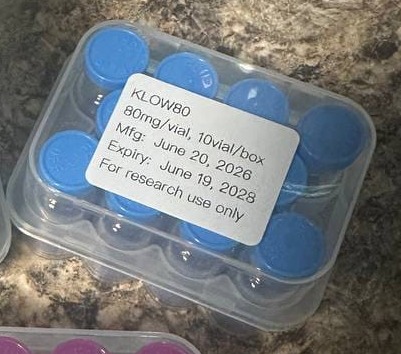
Details from the source.
Source-listed BT10+BP10+CU50+KP10 (SKU Klow80): 80mg*10Vials. PriceList(1).pdf lists 190 per 10 vials but does not specify currency; the website displays $190 per 10 vials in USD per owner instruction. The source row does not establish the supplier-specific item's identity, lot quality, or approval.
- Catalogue code
- Klow80
- Source specification
- 80mg*10Vials
- Source document
- PriceList(1).pdf, page 4
- Photograph
- Owner-supplied photograph; visible package label matched to this catalogue entry. Supplier identity, lot, and product quality have not been independently verified.
Product information is presented from supplied source materials. Inclusion on this website does not state that a product is an approved medicine or authorize human use. This is educational content, not medical advice.
Compound-level research and safety context.
Evidence below concerns the research family associated with this listing. For blends, findings about individual components do not establish evidence for the combination. This does not verify the supplier-specific vial or lot. Reviewed 2026-10-30.
What it is
The source lists Klow80 with the exact formula label BT10+BP10+CU50+KP10, specification *10Vials, and price 190 per 10 vials; currency is not stated. It appears to be intended as a peptide-containing blend, but the exact substances and whether the vial contains peptides cannot be verified from the listing. BP10 is not a source SKU in the supplied list (the BPC 157 SKUs shown are BC5 and BC10). Separate rows associate BT10 with “TB500(Thymosin B4 Acetate),” CU50 with GHK-CU, and KP10 with KPV, but those cross-listings do not establish the contents of the Klow80 vial. Preserve the label and formula without expanding them into asserted identities.
Biological mechanism
No mechanism of action has been established for Klow80 as a combination. If the labels were intended to refer to the separate compounds suggested by neighboring catalogue rows, standalone literature discusses BPC-157 effects on vascular signaling and tissue responses, full-length thymosin β4 as an actin-binding peptide involved in cell migration, GHK-Cu-related cellular/tissue remodeling responses, and KPV-related anti-inflammatory signaling. These proposed mechanisms are based largely on preclinical work, remain incomplete, and cannot be attributed to the unidentified vial or blend.
Research focus
No research focus is established for Klow80. Standalone research on possibly intended components has examined tissue repair and angiogenesis, wound healing, inflammatory signaling, and cellular responses. These are separate research topics and do not demonstrate activity of this combination.
Potential applications in the evidence
No potential application is established for Klow80. Wound/tissue repair and inflammatory processes are among the investigational topics studied for some potentially related standalone peptides, primarily in cells and animals. The source does not verify that the vial contains those molecules, and standalone findings are not evidence for this blend or a human application.
Human evidence
No direct human study of the Klow80 combination was identified in the sources reviewed; an exact-name ClinicalTrials.gov search returned no records, which does not rule out unregistered studies or different naming. Reviews describe very limited human evidence for BPC-157, including small pilot or uncontrolled reports. A PubMed abstract for a topical full-length thymosin β4 venous-ulcer study said it was ongoing and reported 21 participants enrolled at the time; it is not evidence for this vial or for an unspecified TB-500-related material. The GHK-Cu review does not establish injectable safety or efficacy for Klow80. FDA reports no identified human exposure data for drug products containing KPV. No results for the mixture or its human safety and efficacy are established.
Known and potential effects
No adverse-effect profile is established for Klow80. Its ingredients, chemical forms, quality, and route are unverified. FDA identifies potential immunogenicity, aggregation, peptide-related impurities, active-ingredient characterization challenges, and limited or absent human safety information for certain nominated peptide substances or routes; these are regulator-identified concerns in those contexts, not documented adverse events from this exact vial. Do not claim the vial is safe or free of side effects.
Safety and contraindications
The mixture's identity, amount of each ingredient, sterility, manufacturing quality, and product-specific contraindications cannot be verified. FDA notes immunogenicity and impurity/aggregation concerns for certain peptide drug substances and says human safety information is limited or absent for KPV and the specific thymosin β4 fragment LKKTETQ it calls TB-500. These statements do not establish the contents of Klow80. No administration or human-use guidance is supported by the available information.
U.S. FDA / regulatory status
As of 2026-10-30, no FDA approval for the exact Klow80 name or stated four-part formulation was verified. FDA's compounding safety page identifies BPC-157, KPV, the specific thymosin β4 fragment LKKTETQ (TB-500), and injectable GHK-Cu in its “nominated but withdrawn” discussion. That is compounding-substance safety/nomination information, not approval of a product or proof of safety, lawful availability, or equivalence to this vial. The source list does not establish that Klow80 is compounded or research-only. Manufacturer, lot, formulation source, jurisdiction, and any applicable authorization are not provided, so the exact vial's regulatory status cannot be confirmed.
Evidence limitations
The formula's identity is unresolved: BP10 does not match a BPC 157 SKU in the price list, and no ingredient names, sequences, chemical forms, or analytical results are supplied for this specific blend. No combination-specific mechanism, safety profile, stability, interaction, or clinical evidence was identified. Animal and in-vitro findings do not establish human outcomes, and sparse or formulation-specific standalone human research cannot be transferred to Klow80. The catalogue does not establish compounded or research-only status, FDA approval, product quality, or therapeutic claims. The exact source product label, specification, and price are retained; currency is not stated.
Supporting sources
- Certain Bulk Drug Substances for Use in Compounding that May Present Significant Safety Risks U.S. Food and Drug Administration · Regulator safety/compounding status page. Supports: FDA's entries and stated safety/data limitations for BPC-157, KPV, injectable GHK-Cu, and the specific thymosin β4 fragment LKKTETQ; supports regulatory caveats and concern statements, not approval of Klow80.
- Regeneration or Risk? A Narrative Review of BPC-157 for Musculoskeletal Healing PubMed Central / peer-reviewed review · Peer-reviewed narrative review. Supports: Preclinical mechanisms, sparse human evidence, and limitations of BPC-157 research; does not support identity or efficacy of the blend.
- Thymosin beta-4 and venous ulcers: clinical remarks on a European prospective, randomized study on safety, tolerability, and enhancement on healing PubMed / Annals of the New York Academy of Sciences · Human-study abstract. Supports: Design and interim status of a topical full-length thymosin β4 venous-ulcer study, including the abstract's report of 21 participants enrolled; not a completed efficacy result or evidence about the catalogued vial.
- Regenerative and Protective Actions of the GHK-Cu Peptide in the Light of the New Gene Data PubMed Central / peer-reviewed review · Peer-reviewed review. Supports: GHK-Cu biological and preclinical research context, discussion of gene-related effects and mechanistic uncertainty; does not establish this vial's identity or injectable safety/effectiveness.
- α-MSH related peptides: a new class of anti-inflammatory and immunomodulating drugs PubMed Central / peer-reviewed review · Peer-reviewed review. Supports: KPV's relationship to α-MSH and laboratory/animal anti-inflammatory research, including uncertainty about signaling; not evidence of Klow80 human effects.
- ClinicalTrials.gov search for Klow80 U.S. National Library of Medicine, ClinicalTrials.gov · Official clinical-trial registry search. Supports: The exact-name search page displayed no records at the time checked; this is not proof that no unregistered or differently named research exists.