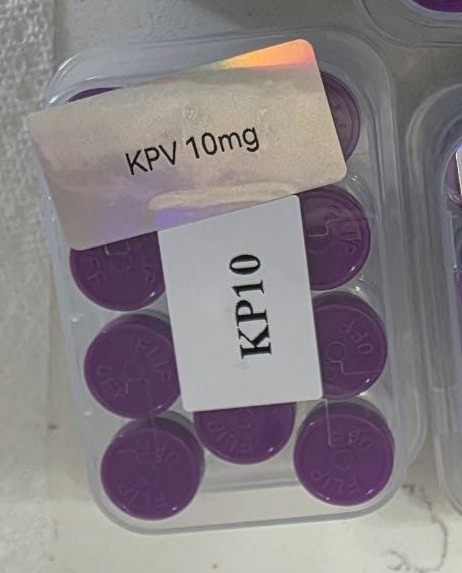
Details from the source.
This catalogue entry records KPV, 10 mg × 10 vials (SKU KP10), using the supplied source listing. The cited dossier describes: Laboratory and animal research has examined inflammatory signaling, intestinal inflammation and induced colitis, and wound-healing models. It also distinguishes available human evidence, limitations, safety concerns, and regulatory context. It does not verify this supplier-specific item’s identity, formulation, lot quality, or approval. This is not medical advice, a treatment recommendation, or authorization for human use.
- Catalogue code
- KP10
- Source specification
- 10mg*10vials
- Source document
- PriceList(1).pdf, page 4
- Photograph
- Owner-supplied photograph; visible package label matched to this catalogue entry. Supplier identity, lot, and product quality have not been independently verified.
Product information is presented from supplied source materials. Inclusion on this website does not state that a product is an approved medicine or authorize human use. This is educational content, not medical advice.
Compound-level research and safety context.
Evidence below concerns the research family associated with this listing. For blends, findings about individual components do not establish evidence for the combination. This does not verify the supplier-specific vial or lot. Reviewed 2026-10-30.
What it is
KPV is a tripeptide (Lys-Pro-Val), so it is a peptide. The catalogue label does not identify whether this vial contains free-base KPV, KPV acetate, or another form.
Biological mechanism
Preclinical studies propose that KPV can enter cells through the PepT1 peptide transporter and suppress NF-κB and MAP-kinase inflammatory signaling, reducing inflammatory cytokine expression. FDA notes that the molecular targets remain unknown. These findings are from cells and animals, not proof of an effect in people.
Research focus
Laboratory and animal research has examined inflammatory signaling, intestinal inflammation and induced colitis, and wound-healing models.
Potential applications in the evidence
Investigated, not established: KPV has been studied in relation to inflammatory conditions, including intestinal inflammation, and wound healing. No human therapeutic application or benefit is established.
Human evidence
Human-derived cell lines have been used in laboratory experiments, but those are not human clinical studies. FDA did not identify clinical studies or human exposure data for KPV by any route. A ClinicalTrials.gov search for KPV returned no registered studies when checked. Human efficacy and safety have not been established.
Known and potential effects
Cell and animal experiments report reduced inflammatory signaling and cytokine expression, and effects in mouse colitis models. There is no characterized human adverse-effect profile. FDA's adverse-event search found no KPV reports through December 3, 2025, but absence of reports is not evidence of safety.
Safety and contraindications
Human risks are unknown. FDA identified no clinical or nonclinical toxicity studies adequate to inform safety for the proposed uses and no human data assessing immunogenicity or aggregation. FDA highlighted gaps in peptide characterization, impurity and aggregation controls, and product quality. These are potential risks and evidence gaps, not confirmed harms from this particular vial. No KPV-specific contraindications are established by the reviewed evidence; this does not imply safety.
U.S. FDA / regulatory status
FDA states that neither KPV free base nor KPV acetate is a component of an FDA-approved drug, and neither has an applicable USP/NF drug-substance monograph. FDA's May 2026 briefing proposed that neither be included on the 503A bulk-substances list; the advisory committee process is separate and its advice is nonbinding. I could not verify a final FDA determination on KPV's 503A listing status by the research cutoff. FDA's Category 2 page current April 22, 2026 lists KPV under withdrawn nominations, not as a then-current Category 2 substance. None of these facts verifies the approval, manufacturer, formulation, or regulatory status of the supplier-specific vial.
Evidence limitations
Evidence is predominantly in vitro and animal research and cannot establish human effectiveness or safety. Findings for research preparations or one KPV form do not identify or establish the properties of this product. The provided catalogue does not state the vial's salt form, manufacturer, lot, formulation source, jurisdiction, or provide a certificate of analysis. Exact-vial identity and approval cannot be verified.
Supporting sources
- FDA Evaluation of KPV-Related Bulk Drug Substances U.S. Food and Drug Administration · Regulatory briefing document. Supports: KPV free base versus acetate distinction; proposed 503A evaluation; mechanism review; lack of human exposure, clinical safety and efficacy data; adverse-event search caveats; safety and characterization gaps.
- PepT1-Mediated Tripeptide KPV Uptake Reduces Intestinal Inflammation Gastroenterology; PubMed Central / National Library of Medicine · Primary preclinical study. Supports: KPV tripeptide identity, PepT1 transport, in-vitro human-derived cell experiments and mouse colitis models.
- Melanocortin-derived tripeptide KPV has anti-inflammatory potential in murine models of inflammatory bowel disease Inflammatory Bowel Diseases; PubMed / National Library of Medicine · Primary animal study. Supports: Preclinical anti-inflammatory findings in murine colitis models; not human evidence.
- ClinicalTrials.gov search for KPV U.S. National Library of Medicine, NIH · Official clinical-trial registry search. Supports: No registered KPV studies appeared in the registry search when checked; search result is not evidence that no unregistered human exposure exists.
- Certain Bulk Drug Substances for Use in Compounding that May Present Significant Safety Risks U.S. Food and Drug Administration · Regulatory safety webpage. Supports: FDA Category 2 page's current listing of KPV among withdrawn nominations and stated limits of what FDA knows about human safety.
- July 23-24, 2026: Meeting of the Pharmacy Compounding Advisory Committee U.S. Food and Drug Administration · Regulatory advisory-committee page. Supports: KPV free base and acetate were considered in a separate 503A listing process; FDA advisory committee advice is nonbinding.