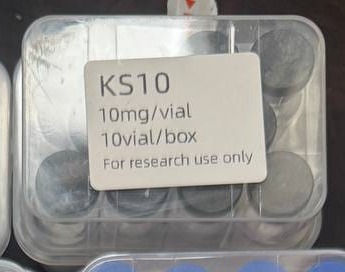
Details from the source.
Source-listed KissPeptin-10 (SKU KS10): 10mg*10vials. PriceList(1).pdf lists 94 per 10 vials but does not specify currency; the website displays $94 per 10 vials in USD per owner instruction. The source row does not establish the supplier-specific item's identity, lot quality, or approval.
- Catalogue code
- KS10
- Source specification
- 10mg*10vials
- Source document
- PriceList(1).pdf, page 3
- Photograph
- Owner-supplied photograph; visible package label matched to this catalogue entry. Supplier identity, lot, and product quality have not been independently verified.
Product information is presented from supplied source materials. Inclusion on this website does not state that a product is an approved medicine or authorize human use. This is educational content, not medical advice.
Compound-level research and safety context.
Evidence below concerns the research family associated with this listing. For blends, findings about individual components do not establish evidence for the combination. This does not verify the supplier-specific vial or lot. Reviewed 2026-10-30.
What it is
Kisspeptin-10 is a ten-amino-acid peptide; the catalogue source lists that exact label, but documentation does not verify the contents or identity of the specific KS5/KS10 vials.
Biological mechanism
Kisspeptin-10 binds and activates the G-protein-coupled KISS1R receptor, also called GPR54. In hypothalamic GnRH neurons, this signaling can promote gonadotropin-releasing hormone (GnRH) activity and downstream pituitary release of LH and FSH, which can affect gonadal sex-hormone secretion.
Research focus
Research examines kisspeptin signaling as a regulator of reproductive hormone release and the hypothalamic-pituitary-gonadal axis, including possible relevance to reproductive disorders. This remains investigational research, not an established use of the listed vials.
Potential applications in the evidence
Investigated as a way to study or modulate reproductive hormone signaling, with research interest in reproductive disorders. Available evidence does not establish clinical benefit or a treatment application for KS5/KS10 or this supplier-specific product.
Human evidence
Small, short human studies show acute hormone responses under controlled conditions: kisspeptin-10 stimulated LH in healthy men and LH/FSH in women during the preovulatory menstrual phase in one study, but did not significantly change reproductive hormones in women during the follicular phase at tested routes/exposures. Study subgroups were generally only four or five participants. These data do not establish fertility or pregnancy outcomes, long-term benefit, treatment efficacy, or chronic-use safety. Evidence for kisspeptin-54 or other kisspeptin forms is not proof for kisspeptin-10.
Known and potential effects
Short-term observed pharmacologic effects include changes in LH, FSH, and testosterone; responses vary by sex, menstrual-cycle phase, and study conditions. FDA notes that most studies had small samples and limited safety reporting and that no published clinical trials assessed chronic or fixed-schedule kisspeptin-10 use beyond one day. FDA summarized one adverse-event report involving a 17-year-old given a compounded kisspeptin-10 product who experienced weight gain and increased estrone; the timing and clinical information were insufficient to determine causality. No serious adverse events were reported in the clinical studies reviewed by FDA, but this does not establish safety.
Safety and contraindications
FDA identifies potential immunogenicity concerns for injectable subcutaneous and intramuscular forms, potentially amplified by peptide aggregates or impurities, and reports limited safety information for proposed routes. FDA also summarized in-vitro vascular-cell and mouse atherosclerosis findings; clinical relevance to humans remains unclear, and these animal/in-vitro findings should not be represented as demonstrated human harms. A complete contraindication profile for these vials cannot be verified; no safety guarantee is appropriate.
U.S. FDA / regulatory status
As of 2026-10-30, FDA’s October 2024 briefing stated kisspeptin-10 was not a component of an approved product in any country at the time of review. FDA’s May 14, 2026 503A list includes kisspeptin-10 in Category 2, bulk drug substances that raise significant safety risks. This compounding-policy classification is not drug approval and does not prove that the listed item is compounded. The PriceList(1).pdf gives no manufacturer, lot, formulation source, jurisdiction, product label, or approval evidence; regulatory status and approval of the exact KS5/KS10 vial cannot be verified. Do not transfer any active-ingredient or other product approval to this item.
Evidence limitations
PriceList(1).pdf lists the exact label KissPeptin-10 with KS5: *10vials, price 56 per 10 vials; and KS10: *10vials, price 94 per 10 vials. It does not specify currency. The PDF does not verify vial identity, manufacturer, lot, formulation, quality, or regulatory status. Human evidence is limited, mostly acute and in small samples; animal and in-vitro findings are distinct from human outcomes. FDA noted insufficient evidence to conclude kisspeptin-10 is effective as a treatment for secondary hypogonadism.
Supporting sources
- Bulk Drug Substances Nominated for Use in Compounding Under Section 503A, updated May 14, 2026 U.S. Food and Drug Administration (FDA) · Official FDA regulatory list. Supports: FDA 503A Category 2 listing for kisspeptin-10 as a substance raising significant safety risks; supports the regulatory-status description.
- FDA Briefing Document: Kisspeptin-10, Pharmacy Compounding Advisory Committee, October 29, 2024 U.S. Food and Drug Administration (FDA) · Official FDA scientific/regulatory briefing document. Supports: FDA mechanism summary, human-study evidence limitations, immunogenicity and impurity concerns, in-vitro and animal safety signals, the adverse-event report, and statement that kisspeptin-10 was not a component of an approved product in any country at the time of review.
- The Effects of Kisspeptin-10 on Reproductive Hormone Release Show Sexual Dimorphism in Humans The Journal of Clinical Endocrinology & Metabolism; PubMed Central · Peer-reviewed primary human study. Supports: Human kisspeptin-10 study methods and acute hormone findings in healthy men and women, including phase-dependent responses and small group sizes.
- Comprehensive Review on Kisspeptin and Its Role in Reproductive Disorders Endocrinology and Metabolism; PubMed Central · Peer-reviewed review. Supports: Background on kisspeptin signaling, KISS1R/GPR54, GnRH regulation, reproductive biology, and research context.