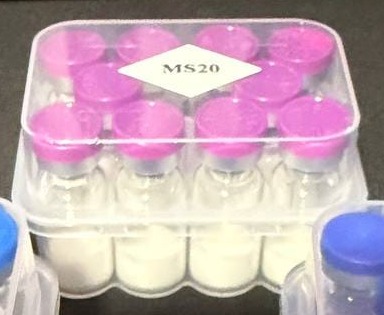
Details from the source.
Source-listed MOTS-C (SKU MS20): 20mg*10vials. PriceList(1).pdf lists 104 per 10 vials but does not specify currency; the website displays $104 per 10 vials in USD per owner instruction. The source row does not establish the supplier-specific item's identity, lot quality, or approval.
- Catalogue code
- MS20
- Source specification
- 20mg*10vials
- Source document
- PriceList(1).pdf, page 3
- Photograph
- Owner-supplied photograph; visible package label matched to this catalogue entry. Supplier identity, lot, and product quality have not been independently verified.
Product information is presented from supplied source materials. Inclusion on this website does not state that a product is an approved medicine or authorize human use. This is educational content, not medical advice.
Compound-level research and safety context.
Evidence below concerns the research family associated with this listing. For blends, findings about individual components do not establish evidence for the combination. This does not verify the supplier-specific vial or lot. Reviewed 2026-10-30.
What it is
MOTS-c is a scientifically defined, 16-amino-acid mitochondrial-derived peptide. This supports classifying the named compound as a peptide, but does not verify the identity, sequence, salt form, strength, or source of any specific catalogue vial. FDA notes that free-base and acetate forms are distinct substances. [1] [2]
Biological mechanism
Cell and animal studies suggest MOTS-c affects folate-cycle and de novo purine-synthesis pathways, with downstream AMPK activation and changes in glucose metabolism. Under metabolic stress it has also been reported to move into the nucleus and influence stress-response gene expression. Its full mechanism and human relevance remain uncertain. [2] [3]
Research focus
Research has examined metabolic homeostasis, insulin sensitivity, glucose handling, obesity, exercise-related muscle responses, and age-associated changes. Cell and animal studies provide most intervention evidence; human research has also measured endogenous MOTS-c during exercise. A registered Phase 2a study is investigating insulin sensitivity in adults with prediabetes and overweight/obesity. [2] [3] [4]
Potential applications in the evidence
Investigated research areas include insulin sensitivity and glucose metabolism, obesity-related metabolism, muscle and exercise responses, aging, and osteoporosis. Most findings for potential applications come from cells or animals and are not established human benefits. The registered Phase 2a study tests insulin sensitivity, but has no results posted. These are research topics, not established uses. [1] [2] [3] [4]
Human evidence
Human studies include measurements of the body's own MOTS-c; one study reported increased muscle and circulating levels after exercise in healthy young men. This is not evidence that administered MOTS-c improves health or performance. ClinicalTrials.gov lists a recruiting Phase 2a interventional study of MOTS-c with no results posted. FDA's May 2026 review said it had not identified clinical studies evaluating the nominated uses, and FDA's compounding-risk page says it had not identified human exposure data for MOTS-c drug products. These different records do not establish efficacy or a safety profile; the trial listing alone does not verify actual exposure or outcomes. [1] [3] [4] [5]
Known and potential effects
No reliable adverse-effect profile for administered MOTS-c has been established. FDA identifies potential immunogenicity for certain routes and concerns about aggregation, peptide-related impurities, and characterization; the agency says important safety information is lacking, including whether MOTS-c drug products could cause harm in humans. [1] [5]
Safety and contraindications
The supplied catalogue does not establish the vial's chemical form, sequence, source, manufacturing controls, sterility, potency, or route. FDA identifies possible immunogenicity for certain routes and risks related to aggregation and peptide impurities. No product-specific contraindications can be verified from the sources reviewed. This information is not a determination that this vial is compounded, research-only, or safe for human use. [1] [5]
U.S. FDA / regulatory status
FDA's May 2026 briefing states that MOTS-c free base and MOTS-c acetate are not components of an FDA-approved drug and have no applicable USP or National Formulary drug-substance monograph. FDA's evaluation for the 503A bulks list said the criteria weighed against inclusion; a separate FDA compounding-risk page lists MOTS-C among substances with significant safety concerns. No specific FDA-approved MOTS-c product was identified in the reviewed sources. The catalogue does not identify a manufacturer, lot, formulation source, jurisdiction, or approval, so the regulatory status of the exact vial cannot be verified; any approval for another active ingredient or formulation would not transfer to it. [1] [5]
Evidence limitations
Most intervention evidence is preclinical, and animal or in-vitro findings do not establish human benefit or safety. Human exercise studies measure endogenous peptide, not treatment effects. The registered Phase 2a trial has no posted results. The label alone cannot resolve free-base versus acetate or verify sequence, purity, amount, manufacturing quality, or whether the catalogue material is the material described in studies. [1] [2] [3] [4]
Supporting sources
- FDA Briefing Document: Pharmacy Compounding Advisory Committee Meeting, July 23–24, 2026 U.S. Food and Drug Administration · FDA briefing document. Supports: MOTS-c identity as a 16-amino-acid peptide; distinct free-base and acetate substances; absence of an applicable USP/NF monograph or FDA-approved-drug component; FDA's evidence assessment and proposed-list evaluation.
- The mitochondrial-derived peptide MOTS-c promotes metabolic homeostasis and reduces obesity and insulin resistance PubMed / Cell Metabolism · Primary peer-reviewed study. Supports: 16-amino-acid mitochondrial 12S rRNA origin; folate-cycle/purine-biosynthesis and AMPK mechanism; preclinical mouse findings.
- MOTS-c is an exercise-induced mitochondrial-encoded regulator of age-dependent physical decline and muscle homeostasis Nature Communications · Primary peer-reviewed study. Supports: Animal exercise/physical-capacity experiments and human evidence on endogenous muscle and circulating MOTS-c responses to exercise.
- MOTS-c for Improving Insulin Sensitivity in Adults With Prediabetes and Overweight/Obesity ClinicalTrials.gov / U.S. National Library of Medicine · Clinical trial registry record. Supports: Registered recruiting Phase 2a MOTS-c intervention study and absence of posted results as of the record reviewed.
- Certain Bulk Drug Substances for Use in Compounding that May Present Significant Safety Risks U.S. Food and Drug Administration · FDA compounding safety page. Supports: FDA's MOTS-C compounding-risk language on potential immunogenicity, aggregation/peptide impurities, limited human exposure information, and unresolved safety.