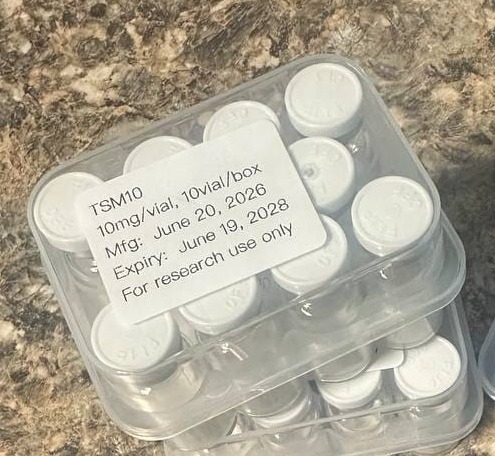
Details from the source.
This catalogue entry records Tesamorelin, 10 mg × 10 vials (SKU TSM10), using the supplied source listing. The cited dossier describes: Human studies have principally investigated reduction of visceral abdominal fat in adults with HIV-associated lipodystrophy. Additional research has examined body-composition and metabolic markers, including liver fat, in selected people with HIV. The FDA label states long-term cardiovascular safety is not established. It also distinguishes available human evidence, limitations, safety concerns, and regulatory context. It does not verify this supplier-specific item’s identity, formulation, lot quality, or approval. This is not medical advice, a treatment recommendation, or authorization for human use.
- Catalogue code
- TSM10
- Source specification
- 10mg*10vials
- Source document
- PriceList(1).pdf, page 3
- Photograph
- Owner-supplied photograph; visible package label matched to this catalogue entry. Supplier identity, lot, and product quality have not been independently verified.
Product information is presented from supplied source materials. Inclusion on this website does not state that a product is an approved medicine or authorize human use. This is educational content, not medical advice.
Compound-level research and safety context.
Evidence below concerns the research family associated with this listing. For blends, findings about individual components do not establish evidence for the combination. This does not verify the supplier-specific vial or lot. Reviewed 2026-10-30.
What it is
Tesamorelin is a synthetic peptide analogue of human growth hormone-releasing factor (GRF/GHRH), modified with a hexenoyl moiety; it is an actual peptide analogue, not a blend. Preserve the source product name exactly as “Tesamorelin.” Source catalogue rows (PriceList(1).pdf, p. 3): TSM2 — *10vials, 51 per 10 vials; TSM5 — *10vials, 94 per 10 vials; TSM10 — *10vials, 165 per 10 vials; TSM20 — *10vials, 304 per 10 vials. Currency is not stated.
Biological mechanism
Tesamorelin binds and stimulates human GRF receptors. GHRH signaling at pituitary somatotroph cells stimulates synthesis and pulsatile release of endogenous growth hormone, which in turn raises IGF-1. Some, but not all, growth-hormone effects are mediated through IGF-1. This describes the known molecule, not the unverified contents of the listed vials.
Research focus
Human studies have principally investigated reduction of visceral abdominal fat in adults with HIV-associated lipodystrophy. Additional research has examined body-composition and metabolic markers, including liver fat, in selected people with HIV. The FDA label states long-term cardiovascular safety is not established.
Potential applications in the evidence
The FDA-labeled application is reduction of excess abdominal fat in adults with HIV-associated lipodystrophy, using an FDA-reviewed branded formulation. Small human studies have also investigated visceral and liver fat endpoints in people with HIV. This evidence does not establish an application for general weight loss, people without HIV, other conditions, or these supplier-specific vials. FDA labeling says tesamorelin is not indicated for weight-loss management.
Human evidence
Randomized placebo-controlled trials in adults with HIV-associated lipodystrophy found reduced CT-measured visceral adipose tissue over 26 weeks. One 412-person trial reported a 15.2% decrease with tesamorelin versus a 5.0% increase with placebo, with increased IGF-1; it did not establish prevention of cardiovascular events or long-term health benefits. A 2024 subgroup analysis of people with HIV on integrase-inhibitor regimens included 38 participants at baseline and 31 with 12-month body-composition data, and reported reductions in visceral and liver fat versus placebo. That small subgroup result is not generalizable proof for other populations or the catalogue items.
Known and potential effects
FDA labeling reports injection-site reactions, arthralgia, pain in an extremity, myalgia and peripheral edema among commonly reported adverse reactions. Other labeled risks include fluid retention, elevated IGF-1, glucose intolerance or diabetes, hypersensitivity reactions and potential malignancy-related concerns. Effects of prolonged IGF-1 elevation are unknown. These are reported for FDA-reviewed Egrifta formulations, not established rates for the catalogue vials.
Safety and contraindications
The FDA label for Egrifta formulations contraindicates use with disruption of the hypothalamic-pituitary axis, active malignancy, known hypersensitivity to tesamorelin or product excipients, and pregnancy. It warns about elevated IGF-1, glucose intolerance/diabetes, fluid retention, hypersensitivity and possible malignancy concerns. These label statements do not establish the identity, formulation, labeling or risk profile of the supplier-specific vials; product-specific safety cannot be verified from the catalogue.
U.S. FDA / regulatory status
FDA Drugs@FDA lists BLA 022505 for prescription Egrifta products containing tesamorelin acetate, originally approved November 10, 2010. FDA labeling specifies reduction of excess abdominal fat in adults with HIV-associated lipodystrophy, not weight-loss management. Approval of the active ingredient in named FDA-reviewed formulations does not transfer to a supplier vial labeled Tesamorelin. The catalogue provides no manufacturer, lot, formulation source, jurisdiction, FDA application or product labeling, so U.S. approval of TSM2, TSM5, TSM10 or TSM20 cannot be verified. Available evidence also does not establish that these items are compounded or research-only.
Evidence limitations
Clinical evidence concerns defined branded formulations and selected study populations, mainly adults with HIV and abdominal fat accumulation. Findings cannot be assumed to apply to different strengths, sources or formulations, or to other populations or clinical outcomes. Long-term cardiovascular safety is not established. The catalogue alone cannot verify the exact vial identity, quality, purity, sterility, potency, regulatory category or equivalence to a branded product.
Supporting sources
- FDA Drugs@FDA BLA 022505 record U.S. Food and Drug Administration · Regulatory database. Supports: FDA application identity, listed tesamorelin acetate products, prescription status and original approval history.
- Egrifta WR Full Prescribing Information U.S. Food and Drug Administration · FDA prescribing information. Supports: Peptide identity and mechanism; labeled indication and use limitations; clinical studies; contraindications, warnings and adverse reactions.
- Metabolic effects of a growth hormone-releasing factor in patients with HIV New England Journal of Medicine; PubMed record, National Library of Medicine · Peer-reviewed randomized controlled trial. Supports: Human placebo-controlled trial findings and reported adverse-event/discontinuation context in adults with HIV and abdominal fat accumulation.
- Efficacy and Safety of Tesamorelin in People with HIV on Integrase Inhibitors AIDS; PubMed Central, National Library of Medicine · Peer-reviewed randomized-trial subgroup analysis. Supports: Human subgroup findings for visceral and liver fat, sample size, and limitations of generalizability.